
This publication by the Design School focused on documenting classroom experiences developed during the Covid-19 pandemic to reduce the amount of class content that was lost due to the classes being via Zoom.
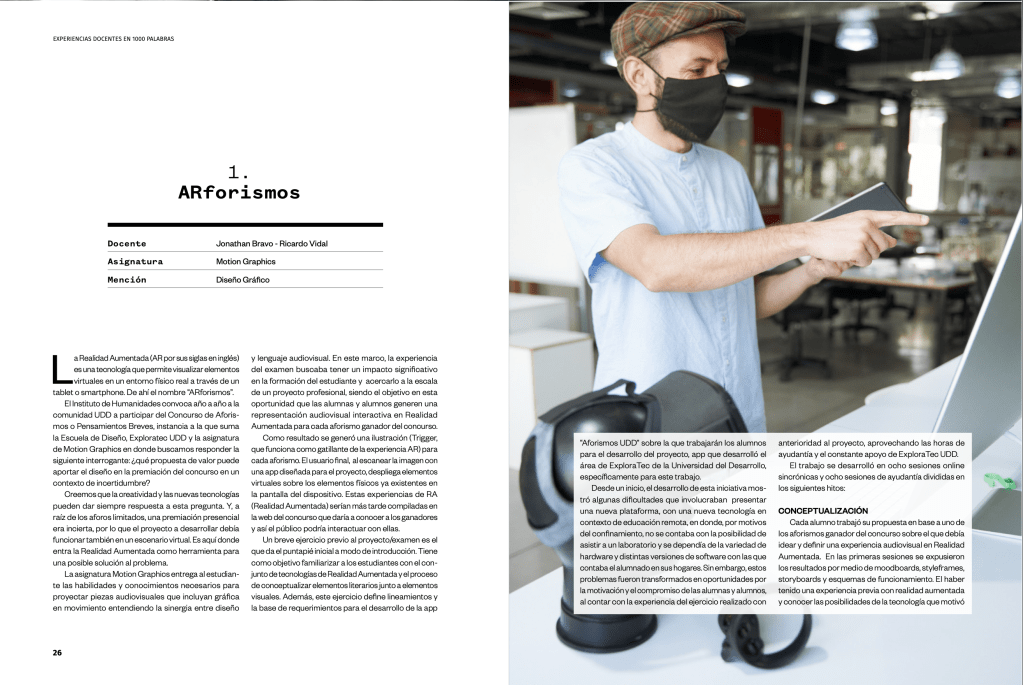
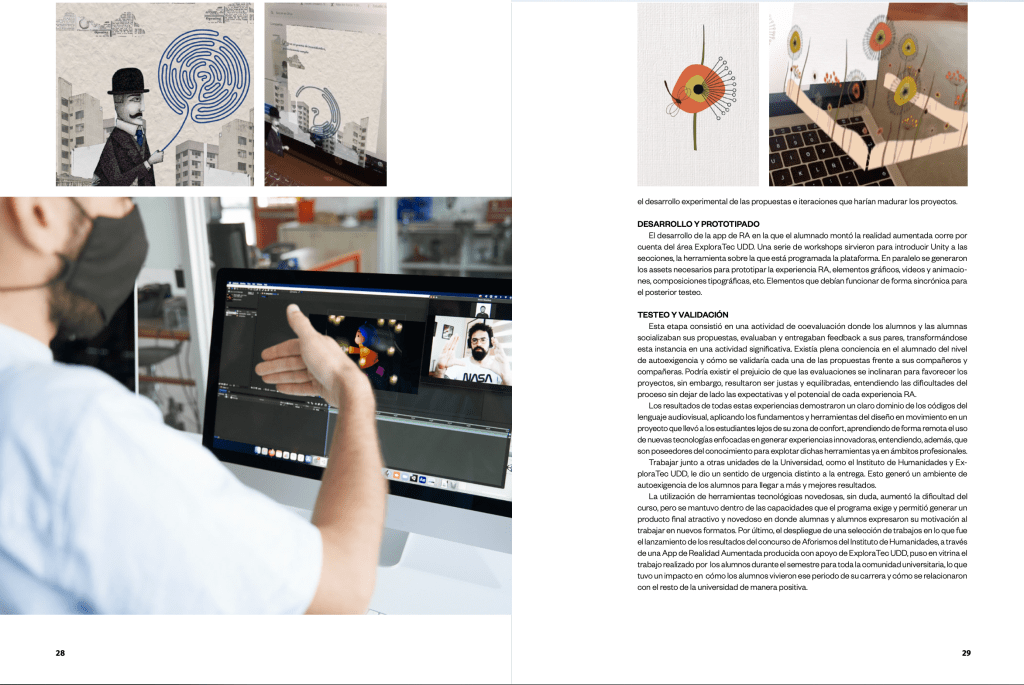
Together with Jontahan Bravo we developed an app to visualize the animations made by the students in their Motion Graphics Course in AR.
This way, the students were able to see their work in a 3D environment. The app also allowed all students to view all their classmates animations, as if they were on the same classroom.
You can download the book (PDF) here.
Translated Article:
Augmented Reality (AR) is a technology that allows visualizing virtual elements in a real physical environment through a tablet or smartphone. Hence the name “ARphorisms”. The Institute of Humanities summons the UDD community year after year to participate in the Aphorisms or Brief Thoughts Contest, an instance to which the School of Design, Exploratec UDD and the Motion Graphics subject add, where we seek to answer the following question: what What value proposition can the design provide in the contest award in a context of uncertainty?
We believe that creativity and new technologies can always provide an answer to this question. And, due to the limited capacity, a face-to-face award ceremony was uncertain, so the project to be developed had to also work on a virtual stage. This is where Augmented Reality comes in as a tool for a possible solution to the problem.
The Motion Graphics course provides students with the necessary skills and knowledge to project audiovisual pieces that include motion graphics, understanding the synergy between design and audiovisual language. Within this framework, the exam experience sought to have a significant impact on the student’s training and bring it closer to the scale of a professional project, the objective being that the students generate an interactive audiovisual representation in Augmented Reality for each aphorism. Winner of the competition.
As a result, an illustration (Trigger, which works as a trigger for the AR experience) was generated for each aphorism. The end user, when scanning the image with an app designed for the project, displays virtual elements on top of the existing physical elements on the device’s screen. These AR (Augmented Reality) experiences would later be compiled on the contest website that would announce the winners and thus the public could interact with them.
A brief exercise prior to the project/exam is the one that kicks off as an introduction. Its objective is to familiarize students with the set of Augmented Reality technologies and the process of conceptualizing literary elements together with visual elements. In addition, this exercise defines guidelines and the base of requirements for the development of the app “UDD Aphorisms” on which the students will work for the development of the project, an app that was developed by the ExploraTec area of the Universidad del Desarrollo, specifically for this work.
From the beginning, the development of this initiative showed some difficulties that involved presenting a new platform, with a new technology in the context of remote education, where, due to confinement, there was no possibility of attending a laboratory and it depended on the variety of hardware and different versions of software that students had at home. However, these problems were transformed into opportunities due to the motivation and commitment of the students, having the experience of the exercise carried out prior to the project, taking advantage of the assistantship hours and the constant support of ExploraTec UDD. The work was carried out in eight synchronous online sessions and eight assistantship sessions divided into the following milestones:
Conceptualization
Each student worked on their proposal based on one of the winning aphorisms of the contest on which they had to devise and define an audiovisual experience in Augmented Reality.
In the first sessions, the results were presented through moodboards, styleframes, storyboards and operating schemes. Having had previous experience with augmented reality and knowing the possibilities of the technology that motivated the experimental development of the proposals and iterations that would make the projects mature.
Development and Prototyping
The development of the AR app in which the students set up augmented reality is the responsibility of the ExploraTec UDD area. A series of workshops served to introduce Unity to the sections, the tool on which the platform is programmed. In parallel, the necessary assets were generated to prototype the AR experience, graphic elements, videos and animations, typographic compositions, etc. Elements that had to work synchronously for subsequent testing.
Testing and Validation
This stage consisted of a co-evaluation activity where the students shared their proposals, evaluated and gave feedback to their peers, transforming this instance into a significant activity. There was full awareness in the students of the level of self-demand and how each of the proposals would be validated in front of their classmates. There could be a prejudice that the evaluations were biased to favor the projects, however, they turned out to be fair and balanced, understanding the difficulties of the process without neglecting the expectations and potential of each AR experience.
The results of all these experiences demonstrated a clear mastery of audiovisual language codes, applying the fundamentals and tools of design in motion in a project that took students far from their comfort zone, learning remotely the use of new technologies. focused on generating innovative experiences, understanding, in addition, that they are holders of the knowledge to exploit these tools already in professional fields.
Working alongside other units of the University, such as the Humanities Institute and ExploraTec UDD, gave a different sense of urgency to the delivery. This generated an environment of self-demand from the students to reach more and better results.
The use of innovative technological tools undoubtedly increased the difficulty of the course, but it remained within the capabilities that the program requires and allowed the generation of an attractive and innovative final product in which students expressed their motivation to work in new formats. Finally, the display of a selection of works in what was the launch of the results of the Aphorisms contest of the Institute of Humanities, through an Augmented Reality App produced with the support of ExploraTec UDD, showcased the work done by students during the semester for the entire university community, which had an impact on how students lived that period of their career and how they related to the rest of the university in a positive way.
 Ricardo Vidal Lynch